
-
Sunjoy Agro is one of China’s leading crop protection companies. It established business in 88 countries, with a global turnover of US$300 million.
Company
-
We believe innovation is the answer to today’s agricultural challenges.
Farming
-
We provide plant protection and plant nutrition products that help build healthy and sustainable food systems.
Solutions
-
Sunjoy Agro implements the concept of sustainability development throughout the corporate mission, philosophy and strategy.
Sustainability
-
Thank you for your interest in Sunjoy Agro. We welcome students and working professionals to apply for opportunities throughout the year.
Join us
Case Studies
We provide plant protection and plant nutrition products that help build healthy and sustainable food systems.
Pest Control in Cucumber Moth
Insecticide
Indoxacarb is an oxadiazine insecticide that acts against a wide range of pest insects. With its broad-spectrum capability, it can effectively control pests from over 30 different families across at least 10 orders. While Lepidopteran insects are the most commonly targeted pests shown on the indoxacarb label, this insecticide can also be used to control many other species of pests, such as leafhoppers, flea hoppers, weevils, beetles, flies, cockroaches, and ants. When indoxacarb droplets come into contact with or are ingested by pests, they cause the pest to stop feeding. This is because the active ingredient blocks the neuronal sodium channel and disrupts the nerve signals within the pest insects.
The cucumber moth, Diaphania indica (Saunders), is a serious pest on melon plants. In addition to attacking the leaves, the caterpillars also target the flowers, which can significantly reduce the number of fruit sets. Furthermore, young fruits are also at risk of being attacked by caterpillars, which can cause damage to the skin and lead to the fruit rotting. It is important to take measures to prevent caterpillar infestations in order to protect plants and ensure healthy fruit production.
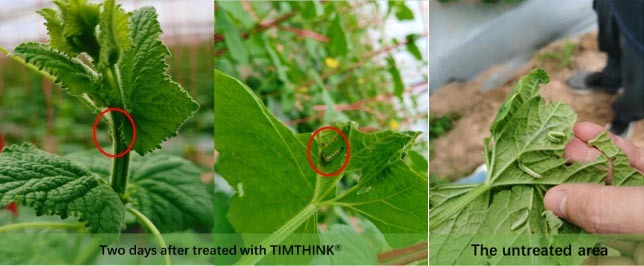
To determine the most effective method for controlling the cucumber moth, we conducted a field trial with Timthink (Indoxacarb 150g/L SC) on September 18, 2013, in Ledong City, Hainan Province. During the trial, we sprayed melon plants with 1000 times dilution of Timthink and checked the status of the caterpillars after 2 days. The results showed that the caterpillars in the treated area were almost entirely poisoned or dead, while the damage caused by caterpillars in the untreated area continued to worsen. These findings suggest that Timthink is an effective method for controlling caterpillars and preventing damage to plants.
Previous
Explore More